(Review-ish!)
It feels like a long time ago now, but once upon a time I was enrolled as a PhD student at the University of York. I was investigating the role of religious houses (two in York, two in London) in their surrounding communities, and I found out some really cool stuff. I won’t go into the details here. Anyway, due to various things I chose to complete as an MPhil instead. I told my wife to make sure that, if I ever made any noises about wanting to do research again, she would remind me about how much I hated it! She had to do that recently after a visit to Norton Priory in Runcorn – a place so beautiful and interesting that I started getting the itch…!
The Tl;Dr Version
To do a ‘review’ in the classic sense would be a bit unfair on a place like Norton Priory. I don’t know that you can ‘review’ a historic building, really. Safe to say, though, this is somewhere that is well worth a visit if you get a chance. From stunning grounds, to ringing bells and a statue of a fat monk that terrifies my dog (see here to understand more about his cowardice), there is a lot to do and see. Admission is reasonably priced and, other than the indoor museum and walled garden area, the site is dog-friendly. Go visit, you won’t regret it!
The Detailed Version
As you turn of the A558 road and into a drab industrial estate, it feels like you are in the wrong place – surely this can’t be the location of a 900 year old building, one of the most excavated monastic sites in Europe (according to their website) and a treasure trove of artefacts from the last 1000 years of history. There can’t really be a garden here that grows such exotic fruit as kiwis and houses the National Collection of Tree Quince, not with all this traffic and pollution around, can there? Nobody in their right mind would come to a place like this willingly, surely…
Yet you continue to drive along the road, wondering if you have taken a wrong turn somewhere. Google Maps clearly doesn’t know what it’s doing anymore. Maybe you should just turn back? But then, nestled unimposingly, at the end of the road you see a sign. As if you’ve crossed some invisible threshold, you are transported as if by magic to one of the most serene and beautiful places that you will find along the shores of the River Mersey. You have arrived at Norton Priory, and are most definitely in the right place!
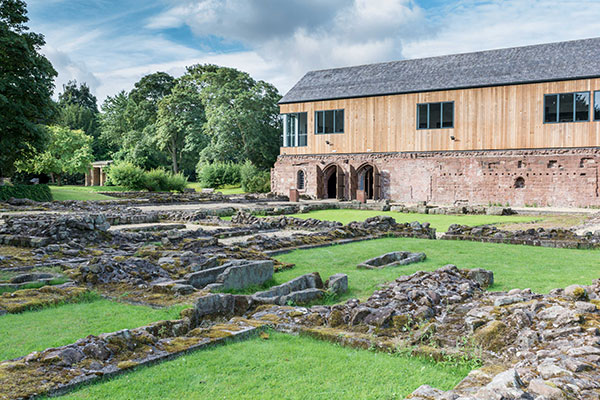
For those who are not familiar, the ‘museum and gardens’ of Norton Priory comprises the remains of a medieval religious house (the eponymous Norton Priory) and its immediate surroundings. The site is what would have once been the immediate holdings of the priory/abbey Cannons (a type of monk) until the Dissolution of the Monasteries by Henry VIII (1536) and subsequently the Tudor and Georgian houses built by the Brooke family on the site of the priory and the Norton Manor. Aside from the forest and meadow-lands that run between the main road and the Bridgewater Canal, there remain extensive foundations from the medieval buildings alongside remains from the later constructions – not to mention the impressive walled-garden and orchard.
When we went, September had just begun. The air still held that faint smell of Summer that lingers as long as it can throughout the first month of Autumn – a season that itself is arriving later and later thanks to global warming. Many wild flowers had seen their best, moving further and further into their gradual yearly decline. Squirrels, of which there are MANY, were hard at work gathering and foraging through the thick forest carpet. Fresh conkers from the horse-chestnut trees had begun to fall, beech seed-pods crunched underfoot, while some Brazilian giant-rhubarb tried to eat us at one point. Ragnar, our dog, absolutely loved it – except for the toll of the replica bell and being inexplicably frightened by a stone statue of a fat monk!
While on the subject of statues, amongst the amazing artefacts surviving from the medieval priory is an 11ft. statue of St. Christopher that has survived since c.1375-1400. This 1.25 tonne statue is the largest statue of St. Christopher in Britain that survives from the Medieval period, and the fact that it still exists is really quite extraordinary. Currently on display in the main building of the site, the statue now is your standard red-sandstone colour, but once upon a time would have been in resplendent colours – a fine testament to the conversion of the priory into an abbey at that time.
I think I should also mention that Norton Priory works in partnership with the Paget’s Association. I don’t want to get technical and risk saying the wrong things, but Paget’s Disease of Bone is a condition that affects the ways in which bones self-repair within the body and, at the more serious end, can result in bone cancer. This condition is prevalent in people from the North West of England and seemingly was a particular affliction that the monastic infirmary had to care for. Indeed, the Dutton family, one of their most generous patrons and principal benefactors, seems to have had members affected by it as well. The museum has various displays about this – including a (very respectful) display of skeletons and bones with the disease.
In short, there is a lot to see and do. Enough for a full day out? Probably, depending on how much you want to explore the grounds at a leisurely pace and how long you spend in the museum section. Worth the price of admission? Definitely. I’ll be honest, I would be very very surprised if you did not fall in love with the place after about five minutes. If not, give it time. It’ll still be there, waiting for you!
—
P.S. I mentioned to my historian/archaeologist friends that I was feeling the research itch and was met with a wall of ‘DON’T DO IT!’. I have the best friends! 😛
 AHF Writes